Sunday, March 16, 2008

Two Bad Ants

A. Title: Two Bad Ants

B. Author: Chris Van Allsburg

C. Illustrator: Chris Van Allsburg

D. Publisher: Houghton Mifflin Company

E. Genre: Picture Book

F. Reading Level: 2-3

G. Summary: Two Bad Ants is a story about an ant community that finds a home with a jar full of sugar. On a trip to collect sugar, the worker ants traveled a long distance at night and traveled up steep mountains to reach the tasty crystals. Two ants decided that this place was heaven, and they wanted to stay behind to enjoy their new found riches. The next morning, while the two ants were sleeping in the sugar jar, a spoon scoops them up and dumps them in coffee! The ants battle the swirling, hot liquid, and manage to get out. Unfortunately, the ants climbed into holes in some bread and got put into the toaster! Once they got out of there, they were drifted away by water in the sink into a garbage disposal. Next, they tried to climb into a outlet and got zapped. Finally, they were so tried they went to sleep in a dark corner and awoke to see the worker ants returned for more sugar crystals. The two ants got back in line, marched home, and were very happy to be home! The illustrations appear to be done in pen and ink; the detailed pictures have a lot of geometric lines and symmetry probably to make the size of the ants to their surroundings pop.

H. Response: I really enjoyed Two Bad Ants for a number of reasons. My favorite part about the book is realizing how tough worker ants must have it. The details in the story and the illustrations of what the ants went through just to get to the food was very interesting. The best part, by far, was the part when the ants were in the home getting tossed around and bruised up because they had no idea what was going on, but as the reader you do know what is happening to the ants! The style of art that Chris Van Allsburg uses in Two Bad Ants is fun, but I like some of his other media styles and choices a bit better. The illustrations were very clear and went along with the story well, but I prefer his style in The Polar Express.

I. Teaching Ideas: Two Bad Ants would be a great picture book to start off a science unit on insects and their characteristics, habitat, or their every day life. On Teacher CyberGuide, I found a lesson plan that includes an activity dealing with Chris Van Allsburg's biography and life, how Chris gets his ideas for stories and illustrations, and ways to create food inspired by insects! I found links on Web English Teacher for multiple lesson plan ideas for Two Bad Ants. Some of the lesson plan topics include collecting information on ants (group work), discussion questions and writing prompts for related creative writing exercises, reading and writing activities to support the book, map-making, different perspectives, etc. I plan to use this book to aid my future lesson plans, especially if ants or insects happens to be the topic.

Little Red Riding Hood

A. Title: Little Red Riding Hood: By the Brothers Grimm
B. Author: Trina Schart Hyman
C. Illustrator: Trina Schart Hyman
D. Publisher: Holiday House
E. Genre: Picture Book - Folklore/Fairy Tale
F. Reading Level: 1-3
G. Awards: Caldecott Honor Award

H. Summary: This is the common fairy tale of Little Red Riding Hood by the Brothers Grimm, retold by Trina Schart Hyman. Little Red Riding Hood, Elisabeth, was given a basket of wine, bread, and sweet butter to take to her sick grandmother's house far away in the woods. Elisabeth's mother made her promise to stay on the path, go straight there and straight back, and to always mind her manners. The walk was about a half an hour away from town, and while Little Red Riding Hood was walking through the woods she met an old, clever wolf. He found out what she was doing, where she was going, and what for before he side tracked poor Elisabeth. She said goodbye to the wolf and left the path to go collect flowers for her sick grandmother. While Elisabeth was picking flowers, the wolf ran all the way to grandmother's house, and he ate her up in one gulp! When Elisabeth got to the house, the door was open and she walked up to the bed. The wolf ate her up too and fell asleep full bellied in grandmother's bed. His loud snoring caught the ear of a hunter passing by, and he came in and cut open the wolf to safe Little Red Riding Hood and her grandmother.

I. Response: I've always liked the story Little Red Riding Hood, and I've been hearing it for as long as I can remember. This particular version has gorgeous illustrations that look to be paintings. The pages with the text have detailed flower borders with the other page being a full illustration with no words. The pictures are all bright and very detailed, especially the faces of the characters. I definitely want to incorporate all of the classic fairy tales/folklore into my future classrooms.

J. Teaching Ideas: Little Red Riding Hood is a great fairy tale, but right off the top of my head I couldn't think of very many teaching ideas. The main lesson plan that I could think of is to share this story while teaching a lesson or unit on folklore or fairy tale. The website for ReadWriteThink has a lesson plan dealing with analyzing fairy tales elements and general characteristics, compose an original fairy tale, and presenting the fairy tales to the class. Lesson Plan Central had a web page with links to 14 different lesson plans that deal with folklore and fairy tales. Online searches pull up lesson plan idea after idea, and Little Red Riding Hood is one that should definitely be included!

Saturday, March 15, 2008

Lon Po Po

A. Title: Lon Po Po: A Red-Riding Hood Story from China

B. Author: Ed Young

C. Illustrator: Ed Young

D. Publisher: Penguin Putnam Books/ Philomel Books

E. Genre: Picture Book/Folktale

F. Reading Level: k-3

G. Awards: Caldecott Award Winner


H. Summary: The story of Lon Po Po is the Chinese version of Little Red Riding Hood. There are a lot of similarities, but also a lot of differences. A mother and her three daughters lived out in the countryside, and one day the mother left to go visit the children's grandmother for her birthday. A clever wolf lived in the woods nearby and saw the mother leave. That night the wolf dressed up, knocked on the door, and claimed to be the three little girls' grandmother, Po Po. At first the children were deceived and aloud the impostor Po Po to come inside. Then, while in bed, the children noticed the wolf's bushy tail and its' sharp claws. The children figured out that their Po Po was actually the wolf and tricked it! They ran outside to get a nut from the gingko tree, which they told the wolf with one taste you could live forever. The three little girls climbed all the way up the tree and convinced the wolf to get a basket, throw a rope over the highest tree branch, and create a pulley system for them to lift their "Po Po" to the nuts. At first, the eldest tried to pull "Po Po" up, but half way up she dropped the wolf saying she was too weak. Next, two of the sisters pulled the wolf up in the basket even higher than the first time, but again, they were too weak to pull the wolf all the way up. The wolf was growing very angry, but all he could think about was the gingko nut and living forever. Finally, all three sisters pulled the wolf up all the way to the top of the tree and dropped him to his death. When the mother arrived home the next, the children told her all about how they had outsmarted the impostor Po Po. The illustrations are done in pastels and water color, and each page varies on the spread layout (panel layout).

I. Response: I have always really enjoyed myths, fairy tales, and folk tales, which is why I think I enjoyed Lon Po Po so much. Little Red Riding Hood is such a common tale that you're sure to hear it if you grow up in the United States! Many of my friends said that they read this Chinese version during their elementary school days, but I was not so lucky. I love the similarities between the two stories, but I have to admit that I like Lon Po Po better than Little Red Riding Hood. The thing that I like the most about it is the creative way the young children outsmart the wolf. Just like Red Riding Hood, the children in Lon Po Po are smart enough to realize that the wolf is not their grandmother, but the Lon Po Po characters go even further and trick the wolf. The illustrations are just amazing. I am a big fan of the way pastels can be combined, rubbed, and molded into unique colors specific to the story it's telling. The color choices are bright, fun, and really compliment the natural settings that they depict.

J. Teaching Ideas: After reading Lon Po Po, I had a few vague ideas for lesson plans right off the top of my head: comparing/contrasting America's folk tales to those of other countries, and teaching Chinese culture. Once I started to look online I found resource after resource for Lon Po Po; this is definitely a book I would suggest using in a lesson plan because of the number of lesson plan opportunities it presents. Right away I found three great lesson plans: TeacherVision lesson plan, UVM (Vermont) lesson plan, and a scholastic lesson plan. The first lesson plan has five great ideas for incorporating this book into the lesson plan including creating a Venn Diagram comparing and contrasting Lon Po Po to Little Red Riding Hood, creative connections for art, social studies, and math, discussing the book from the wolf's point of view and creating another character to present the story from their view point, Chinese inventions word search (have students find out what products/inventions they've used from China), and reproducing Chinese symbols. The UVM website has a lesson plan that includes discussing what the story tells about the culture it's from, how do Lon Po Po and Little Red Riding Hood compare, etc. The Scholastic lesson plan allows children to have a discussion about which story they liked better and why, explore the aspects and create panel art, and appreciating the vocabulary in the Chinese version such as "Hei yo."

Beware of the Storybook Wolves

A. Title: Beware of the Storybook Wolves

B. Author: Lauren Child

C. Illustrator: Lauren Child

D. Publisher: Scholastic Press, a division of Scholastic Inc.

E. Genre: Picture Book/Fairy Tales

F. Reading Level: k-3

G. Summary: Each night, Herb's mother reads him a story before bed. Sometimes it's Little Red Riding Hood with two scary wolves: one big one and one small one with an eye patch (the one on the book's back cover). Before his mother leaves, Herb always makes sure she takes the book with her because of the storybook wolves. In the dark, he hears the low grumbling, growling of wolves, and Herb realizes his mother accidentally left Little Red Riding Hood in his room! The wolves want to eat him, but he convinces them he is dessert and that first they need to eat an appetizer. Then, while Herb is stealing Jell-O from the fairytale book, the wicked witch inside tells the wolves Herb has tricked them. Herb then borrows Cinderella's fairy godmother to protect him. Once all the storybook creatures had been returned, Herb stacked all his books up and put his bed on top to make sure no more storybook creatures decided to come out that night!

H. Response: Beware of the Storybook Wolves has the same media types and styles as I Will Never Not Ever Eat a Tomato, both by Lauren Child. This book also has double page spreads with most of the words worked into the pictures. Lauren Child's media style allows her books to be bright and colorful so that they're both fun to read and to look at. I thought the idea of the fairytale characters coming to life at night is great fun and a great way to introduce different fairy tales. My favorite illustration in the book was when Herb dumped Cinderella's fairy godmother onto the floor and real sequins fell out with her!

I. Teaching Ideas: Scholastic has a lesson plan for Beware of the Storybook Wolves dealing with reading comprehension and can be taught k-3. The goal of the lesson plan is for the children to make connections between the fairy tales that are present in the book, and others not included, and then the students will have the chance to create their own "fractured" fairytale; drawing paper, chart paper, and crayons and markers are all you need. Children get to draw their favorites characters or favorite parts in the story. The lesson plan really sounds like a lot of fun and something younger elementary aged students would really enjoy. I also found a website called "Fairy Tale Resources and Books" on TeacherNet that has a lot of great lesson plans and lesson resources dealing with Fairy Tales, myths, etc.

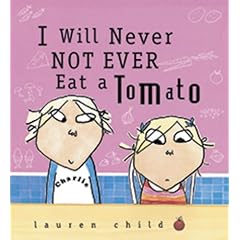
I Will Never Not Ever Eat a Tomato


A. Title: I Will Never Not Ever Eat a Tomato
B. Author: Lauren Child
C. Illustrator: Lauren Child
D. Publisher: Orchard Books/Candlewick Press
E. Genre: Picture Book
F. Reading Level: k-2

G. Summary: The illustrations are done in mixed media. Charlie gets asked by his parents to feed his little sister, Lola, dinner. Lola happens to be an extremely picky eater and doesn't like anything, especially what was for dinner that evening. To help get Lola to eat the food, Charlie made up stories about foods from different planets, from under the sea, or from the clouds on the highest mountains of Fuji. In the end, Lola asks to try the tomatoes without Charlie having to make up a story!

H. Response: The illustrations in this book are very creative, bright, colorful, and fun. I love the way Lauren Child incorporated multiple types of media into the illustrations: drawings, real-life pictures, digital imagery. The illustrations are double page spreads with the words mostly written into the pictures. I think the creative, funny tales Charlie made up made a perfect story to list and teach young students about foods. I also loved how Lola trusted her older brother and wanted to be like him. Not only does this book make it easy for young children to associate food words with the matching pictures, the stories about each food are very entertaining.

I. Teaching Ideas: I Will Never Not Ever Eat a Tomato is a great book to teach young students about different types of foods and the food pyramid. There are many creative ways to incorporate this book into a lesson. One way would be to read the book as a class, name all of the foods in the book, and in groups, color and cut out pictures of the foods to place in a giant food pyramid. One lesson plan I found online included parental involvement with tasting new foods from the book! There is also a suggestion for having a "name the food day" in the classroom that allows the students to taste the different foods and put the correct name with them. These are just two ideas, but there are many other creative lesson plans that could be derived out of I Will Never Not Ever Eat a Tomato.

Friday, March 7, 2008

Swamp Angel

A. Title: Swamp Angel

B. Author: Anne Isaacs

C. Illustrator: Paul O. Zelinsky

D. Publisher: Penguin Books Australia Ltd.

E. Genre: Picture Book - Folktale

F. Reading Level: 1-3

G. Awards: Caldecott Honor Book

H. Summary: Swamp Angel is a fun twist on a legend like Paul Bunyan. The book is about a gentle giant that is a woman, Angelica Longrider AKA Swamp Angel, who enters a competition to rid the towns of Tennessee from a bear named Thundering Tarnation. Thundering Tarnation had eaten out storages of food for winter in at least half of Tennessee! Many men signed up to try and defeat Thundering Tarnation, but not one of them could overpower such a massive bear. Then Swamp Angel and Thundering Tarnation get into a wrestling fight that lasts for days and nearly destroys the countryside! Trees fell down left and right, and the two wrestled for so long that they soon fell asleep. The snores from the two of them was enough to continue to knock down trees, and the tree that killed Thundering Tarnation in his sleep was one that fell down from a snore! The meat from the bear was enough to feed the starving people of Tennessee all winter, and Swamp Angel got to keep his fur as a rug. But don't worry Thundering Tarnation isn't forgotten, during the fight he was thrown into the sky and made a lasting impression in the stars as a constellation. The illustrations are oil paintings on cherry, maple, and birch veneers.


I. Response: I really enjoyed Swamp Angel!! I've never even heard of this story, but it's nice to see a women in a position like Paul Bunyan. It's also a story in the Appalachian region! I also love how even though she was larger than life, the people of Tennessee still didn't think that she could take on a bear like Thundering Tarnation... that was a job for a man. But guess who is the only one that can stop the bear, Swamp Angel! Not only is the story fun, it also has a great message: don't let anyone ever tell you what you can and cannot accomplish; if you try hard enough, you can achieve anything! I also absolutely love the way Paul O. Zelinsky illustrated this book. The pictures have great warmth, depth, and detail in them, and I thought it was a great touch since the story took place outside in the Tennessee woods. It's very easy to see why this book is a Caldecott Honor Book, though I think it should have won!

J. Teaching Ideas: Swamp Angel can be used a fun classroom folktale or has a way to teach a moral lesson: never let anyone tell you that you can't achieve your dreams. I found a lesson plan on folktale and folk art that can be taught with Swamp Angel. The lesson plan can be used in the age range of 9+ years old. The lesson includes a hands on experience where the students get to create their own art mimicking the style of Paul O. Zelinsky. There are also many lesson plan connections that could teach characteristics of folk art and/or folktales.

Tuesday, March 4, 2008

My Friend Rabbit

A. Title: My Friend Rabbit

B. Author: Eric Rohmann

C. Illustrator: Eric Rohmann

D. Publisher: Roaring Book Press, a division of the Millbrook Press

E. Genre: Picture Book

F. Reading Level: K-1

G. Awards: 2003 Caldecott Medal

H. Summary: My Friend Rabbit is very clever and funny story for beginning readers. The story is a mix between text and picture pages and also just picture pages. The illustrations are done in hand-colored relief prints and are very bright and fun. The background is a pretty blue sky, each character has a thick black outline and detailed features. The narrator is a tiny mouse who has a friend that is a rabbit, and everywhere rabbit goes trouble follows! Rabbit accidently gets their toy airplane stuck high up in a tree, but he has a plan. He stacks an elephant, a rhino, a hippo, a moose, an alligator, a squirell, a bear, and a goose and all her young ones one on top of the other. The plane is still just out of reach so rabbit and mouse climbed up and stretched, and then all of a sudden everything shook and everyone fell. The animals were not happy, but the plane had fell and rabbit was mouse's friend; so the mouse scooped up rabbit in the plane and they flew away. As they were flying away rabbit wanted to hug mouse to show his appreciation but was actually covering his eyes!

I. Response: My Friend Rabbit is a great picture book. It has the thrity-two pages, two-page spreads, and wonderful illustrations. My favorite page is the one where all the animals are looking at him very angry because they had all just fallen down on one another. The expressions, details, and colors are amazing and very vivid. This story is sure to remind kids of an older friend or sibling who is bigger than them and sometimes wild.

J. Teaching Ideas: Scholastic.com has a k-1 lesson plan for mathematics and number sequencing using My Friend Rabbit. It includes making copies of a page for each student, cutting, gluing, and rearranging the animals in certain orders. Lessons dealing with friendship and trouble would be easy to apply. The illustrations would be a lot of fun to try to immitate or make your own using the style. Once you read this book, it's really clear why it won the Cadlecott Medal in 2003. The teacher could also just read this book for fun and enjoyment because the students will definitely love it.