Showing posts with label Poetry Books. Show all posts

Monday, April 21, 2008

Tap Dancing on the Roof: Sijo (Poems)

A. Title: Tap Dancing on the Roof: Sijo (Poems)

B. Author: Linda Sue Park


C. Illustrator: Istvan Banyai


D. Publisher: Clarion Books a Houghton Mifflin Company Imprint


E. Genre: Children's Poetry; Sijo Poems


F. Reading Level: 2+


G. Summary: The beginning of Tap Dancing on the Roof has an explanation on Sijo poetry. "All the poems in this book are sijo. Sijo is a traditional Korean form of poetry. Like a Japanese haiku, a sijo is written using a syllabic structure. In its most common form, a sijo in English has three lines, each with fourteen to sixteen syllables. Because the lines can be quite long on the page, sijo in English are sometimes divided into six shorter lines..." The sijo poems that are in this book are both three lines and six lines. The poems are all different with varying topics, and the end of sijo poems usually has a suprise, special twist, or joke. Some poem titles include "Long Division," "Brushing, "Ocean Emotion," "Echo," November Thursday," and "Botany Lesson." The illustrations are drawings done in ink with mostly black, but other colors are present throughout the illustrations. Most of the illustrations are single page spreads, but for a few poems, like "October" below, they're double page spreads.

H. Response: I absolutely love this book because I have never even heard of a Sijo Poem before. In school I was taught all about haiku poetry, but I never learned about the Korean form of poetry. The children's poetry in Tap Dancing on the Roof falls into the category of form poems; the haiku poem also falls into this category. The book itself is extremely helpful in understanding what a Sijo is. The beginning has an excellent page devoted to explaining the Sijo, while the end of the book has an author's note, historical background information, furhter reading suggestions, and tips for writing your own Sijo. This book is basically screaming classroom application because everything you need for a lesson plan is in this book. The illustrations in this book are very interesting and vary greatly between poems. Some illustrations have colored ink and others just have black. My favorite illustration goes along with the poem below, "October." It has a two page spread with the branches, leaves and everyone's hair billowing in the wind, all done in a grey color scheme.

I. Teaching Ideas: Straight off the top of my head, this would be an excellent book for a writing poetry lesson plan. Not only is the book full of fun and interesting examples of Sijo poetry, but there is also a very clear explanation of the sijo poem and tips for writing your own. Tap Dancing on the Roof can be read as a class and then the students can experiment writing their own sijo poems. The whole class could write and illustrate their poems and compile a book and each student could have a copy. There could be a unit that combines sijo and haiku poetry that could involve historical information, reading examples of the poetry, and creating their own.

J. Favorite Poem:
"October"

The wind rearranges the leaves,
as if to say, "Much better there,"
and coaxes others off their trees:
"It's lots more fun in the air."

Then it plays tag with a plastic bag,
and with on gust uncombs my hair!

I love this poem because it is so playful. My favorite thing about it is how the wind takes on personality and characteristics. There are many fun poems in here that would be great for in class exercises.

Sunday, April 20, 2008

It's Snowing! It's Snowing!

A. Title: It's Snowing! It's Snowing! Winter Poems

B. Author: Jack Prelutsky


C. Illustrator: Yossi Abolafia


D. Publisher: HarperCollins Publishers Inc. & An I Can Read Book


E. Genre: Poetry


F. Reading Level: 2-3


G. Summary: This is a wonderful book of winter and snow poems! A cute short poem in It's Snowing! is called "Stuck in the Snow: Stuck in the snow, - dad's pickup truck. 'Sorry, dad, - that's your bad luck.' - 'Shovel it out!' - he smiled and said. - I guess it's my bad luck instead." The book progresses from the last leaf falling and bird leaving to end autumn through to when the snowman is almost completely melted away as spring is on its way. There are short winter days, snowball fights, and ice skating trips. Some of the poem titles include "It's Snowing! It's Snowing!," "One Last Little Leaf," "Winter Signs," "I am Freezing!," "When Snowflakes are Fluttering," and "The Snowman's Lament." Each poem has illustrations to go along with it that are detailed and a lot of fun. The illustration spreads vary depending on the size of the poem and the poem itself. The illustration sizes are full single page, half page, and one fourth page. The medium appears to be watercolor paints, and they are bright, friendly, fun, and great for younger children's literature.

H. Response: I really enjoyed Jack Prelutsky's poems. They have a perfect combination of an essence of childhood and being a kid mixed with all the feelings that come along with the winter season. The book is an easy read, and I had fun reading the whole thing; each poem was a small story inside the whole story of all the poems. The poems in It's Snowing! fall into the lyric or expressive category because the tell about the different characteristics of winter. Some of the poems were about enjoying the winter perks like snow and snowmen, but some of the poems were about freezing or the strong winds; both of the views on winter made a the poems all together feel like they really captured winter. The illustrations are bright and cherie with the cover being my favorite illustration in the whole book. I love the way the snowflakes looking falling down on the little boy's face with the warm yellow background.


I. Teaching Ideas: It's Snowing! would be such an excellent poetry book for classroom application, especially if you were wanting to incorporate seasonal changes: the end of autumn, winter, and into the the start of spring. In the student activities section of Scholastic's website, there is a great exercise where students can learn about Jack Prelutsky's poetry techniques, get help brainstorming for their own poem, steps to help write the poem, and then the students publish them online. The TeachersCorner.net has a lot of great resources for winter activites and lesson plans, thematic units on Jack Prelutsky, and ice and snow units.

Wednesday, February 27, 2008

Big Talk: Poems for Four Voices


A. Title: Big Talk: Poems for Four Voices

B. Author: Paul Fleischman

C. Illustrator: Beppe Giacobbe

D. Publisher: Candlewick Press

E. Genre: Poetry Book/Picture Book

F. Reading Level: Grades 1-3
G. Summary: Big Talk: Poems for Four Voices is another one of Paul Fleischman's creative poem books for multiple people to read aloud. These books are great for classroom application because kids think they're just so much fun. This book has some similar features to those in Joyful Noises and I am Phoenix, but it only has three poems: "The Quiet Evenings Here," "Seventh-Grade Soap Opera," and "Ghosts' Grace." At the beginning of the book there is a two page spread that has instructions on how to read this book, helpful hints, and the table of contents. This book is most noticably different than its sister two-voice poem books because there are four voices. Each reader chooses a color at the beginning (green, yellow, orange, or purple) and that is the line they read throughout the book. The illustrations in this book are made using Photoshop and Painter. The book is overall very bright and there is color everywhere, unlike the black and white sketches in both Joyful Noises and I am Phoenix. The poems in this book have even more of a melodic sound to them.
H. Response: I loved the illustrations in this book; the whole thing is very colorful, bright, and vibrant. The book's illustartions kind of scream fun and they do account for a good portion of the fun. Each page pops because not only are there colorful, childlike illustrations but each reader's section is coded in a different color. I enjoyed the poems themselves because they were a lot of fun, they are amazing to look at, they had a great sing-songie flow to them that made them all the more entertaining. The only negative thing about this book is that I see it more as a fun book rather than a impressive educational text.
I. Teaching Ideas: I would suggest using Big Talk: Poems for Four Voices with younger to middle grades in elementary school. The book can be a great resource for aiding children in their reading/oral reading. The kids can break into groups of four and practice the poems and present them orally as a way to increase their oral reading skills. This book can also be used to teach lessons on poem structures and characteristics because Big Talk has so many fun words that create rhythms and there are rhyming words, the list does in continue on a bit in the subject field. Like I said above though, I would use this book as more of just a fun classroom addition, something to get kids interested in Poetry, but not neccessarily the best book to plan many lessons around. Paul Fleischman's books Joyful Noises: Poems for Two Voices and I Am Phoenix: Poems for Two Voices are much better resources for class lesson plans.

Tuesday, February 26, 2008

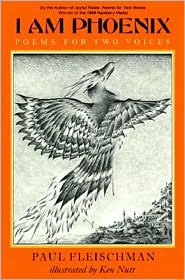
I am Phoenix

A. Title: I Am Phoenix


B. Author: Paul Fleischman


C. Illustrator: Ken Nutt


D. Publisher: HarperCollins Publishers


E. Genre: Poetry Books - Informational Texts - Picture


F. Reading Level: Upper Elementary, Grades 5+


G. Summary: Paul Fleischman wrote this book after he wrote his Newbery Medal for Joyful Noises: Poems for Two Voices. Just like that book, I Am Phoenix is also a book for two voices. However, there are two things that are different between books. I Am Phoenix is about birds, instead of insects, and the poems are written about the birds, not in the birds' voice. The poems discuss the way different birds move, where they live or habitat, distinct characteristics, birds of prey's hunting habbits, etc. The poems have a lot of onomatopoeia words like fluttering and flitters, a lot of words that give you great sensory details. The illustrations are amazing and are done by the same person who did the illustrations for Joyful Noises. Just like its brother book, I am Phoenix has illustrations that are sketches and are very elaborate. Ken Nutt has some great at night sketches, especially for the poem "The Wandering Albatross," which has a gorgeous ocean, ship, and a detailed clear, starry sky.

H. Response: Just like Joyful Noises: Poems for Two Voices, I really enjoyed I Am Phoenix. Both book have great teaching opportunities, but this book has a lot of older classroom applications that pop out to me as well. Like I touched on in the above section, the illustrations are great, pretty much captivating. There is a great sketch of a man pulling a stallion and you can see every detail in the man, the stallion, and the dry, cracking mud they're walking on. There are poems and sketches on birds like finches, albatrosses, pigeons, doves, the phoenix, sparrows, and the list goes on. The poems were also really informative, and by the end of the book I had learned something new about pretty much every bird I read about in the book.

I. Teaching Ideas: There are a ton of teaching ideas that I can think of off the top of my head before ever looking for a lesson plan. For younger students, group projects on birds or habitats would be great; that doesn't even have to be restricted to the younger grades. This book is definitely more difficult than Joyful Noises and so I think it would be most useful in upper elementary school and middle school. The book has great references and information on habitats, environments, survival characteristics, and the list goes on. The class could split into groups, make costumes and have an oral presentation of their poem and their research. The students could do a general research project on the bird, or get even more specific and do a more specific topic like just habitats, characteristics, etc. Then there are also a ton of Language Arts and English applications: copying the poem format, studying terms like onomatopoeia, and again the list keeps going. This is definitely another great addition of Paul Fleischman's books for the classroom.

Saturday, February 23, 2008

Joyful Noises: Poems for Two Voices


A. Title: Joyful Noises: Poems for Two Voices

B. Author: Paul Fleischman

C. Illustrator: Eric Beddows (Ken Nutt)

D. Publisher: Harper & Row, Publishers

E. Genre: Poetry

F. Reading Level: All ages, 9-12

G. Awards: Newbery Medal


H. Summary: This is a wonderful scientific thinking poetry book! Joyful Noises: Poems for Two Voices is a collection of poems about insects and their lives. The greatest part about this book is the fact that it is meant to be read aloud by two people. A great example from the book would be the poem "Honeybees." The two voices are the Queen Bee and the Worker Bee, and they show the great contrast between their daily activities and lives. Not only is this book extremely interesting and fun to read aloud, it has great facts about the insects the poems are about. Also included in the book are poems about grasshoppers, water striders, mayflies, book lice, moths, digger wasps, whirligig beetles, and more.

I. Response: I absolutely love Joyful Noises: Poems for Two Voices. Each poem was so unique and funny and educational. I believe that the poems in this book are free verse because this type of style gives Paul Fleischman the freedom he needs to create the two points of view (two voices) in each poem. My favorite poem in the book is called "Book Lice" and is about two book lice who meet and fall in love despite their different book tastes! Not only does this book have vast educational applications, it's just an overall fun read. I would absolutely recommend this book to teachers, future teachers, and everyone else. Another great thing about this book are the illustrations. The illustrations' media is definitely pencil sketches, but they're extremely detailed and really aid in the telling of the poems. I honestly have never seen such elaborate and gorgeous drawings, especially the illustrations of the outdoors and nature.

J. Teaching Ideas: There are so many different teaching possibilities that can be pulled from Joyful Noises: Poems for Two Voices. For younger students, Joyful Noises can be used as a fun way to introduce scientific concepts. The students can form groups, pick a poem, research the insect, and then orally present the insect research and perform the poem itself. can also be used as inspiration for writing exercises. Students can use these poems as a reference to create their own free verse poems or their own two voice poems. The class as a whole can make costumes to look the insects and put on a performance of the book for their parents or peers. This book can also be used in much older grades, such as those in middle school and high school. Again, you can use Paul Fleischman's writing style as a guide to write their own poetry. Comparing Joyful Noises: Poems for Two Voices and I Am Phoenix: Poems for Two Voices, another one of Paul's book of poems for two voices about birds, could be a great comparison essay prompt. Other essay prompts could come from Paul Fleischman's literature and poetry being compared to a variety of other writers. Like I said, there are numerous ways to apply Paul Fleischman's Joyful Noises: Poems for Two Voices to the classroom on a variety of grade levels.